
Residents in any town would be surprised to learn just how many local talks and events take place across our libraries, and how much you can learn about local history.
I visited Pyle Library this week to hear a fascinating talk by Stefanie Van Stokkom, the Heritage Development Manager for Awen, and learned so much about the history of Kenfig – residents may be interested to know just how prominent a role it played in our regions’ history. Stefanie is incredibly knowledgeable and the well-attended talk was very much like story time for grown-ups, who all listened intently.
Most Libraries hold talks like this, and they tend to be very popular, bringing people of all ages together – and for me, I noticed how everyone was putting down their phones and just listening – so if you get the chance to go to a talk – please do! It inspired me to research a little more and I am so grateful that Richard and I had the opportunity to attend.
For both of us, Kenfig is a special place, particularly Richard, who has so many happy boyhood memories of climbing the dunes, and of happy days spent at Kenfig Pool. It’s hard to believe that some of the historic remnants of this area can still be seen, both in the landscape itself and in the upstairs of the nearby Prince of Wales Inn, which boasts much of the old town’s heritage.
Anyway, here’s a summary of what I learned and I hope our readers enjoy reading more:
—
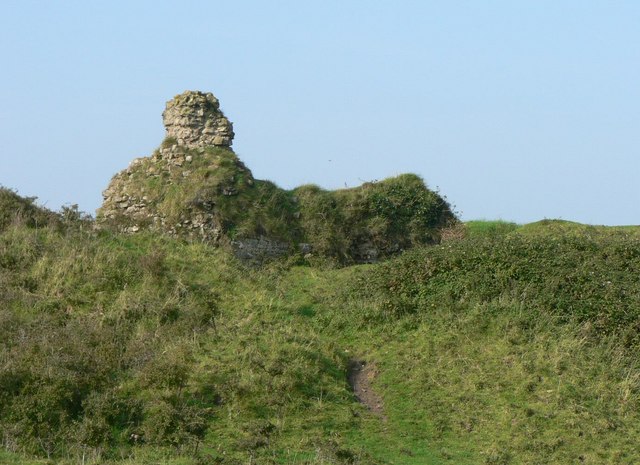
Kenfig, a once thriving medieval town in South Wales, UK, and the site of the historically significant Kenfig Castle, boasts a rich and fascinating history.
While there is a mention of an early castle at Kenfig dating back to 1080, attributed to the refurbishments done by Iestyn ap Gwrgan, this is generally believed to be a different structure. The town of Kenfig as we know it dates back to the 12th century, and was once a bustling port trading in various goods including wool, timber, and corn. The settlement was established by Robert, Earl of Gloucester, around the same time as the construction of Kenfig Castle, which was intended to act as a defensive measure against the Welsh uprisings that were common during the period.
Kenfig Castle, built around 1140, was a prominent Norman stronghold and a key symbol of English power in the region. The stone keep, surrounded by a protective moat and walls, provided an elevated vantage point, giving strategic advantage over potential attackers. During the early 13th century, the castle underwent significant fortifications under the control of Henry III.
However, in spite of its fortified nature, Kenfig Castle was not exempt from violent attacks. It was subjected to several Welsh raids, most notably those led by Morgan ap Caradog and Llywelyn the Great in the early 13th century. The castle was eventually captured by the Welsh in 1232, before returning to English control in 1248.
By the late 13th century, Kenfig was granted a royal charter, confirming it as a borough. The town prospered for some time, even boasting a market and a fair, showcasing its commercial significance. Despite this, Kenfig and its castle were not destined to survive long term.
A defining characteristic of Kenfig’s history is the encroachment of sand dunes, a natural disaster that would lead to its eventual downfall. The process of ‘sand-blow’, where strong winds drive the movement of sand inland, began in the 13th century, gradually burying the town and its surroundings. Despite efforts to save the town, by the end of the 15th century, much of Kenfig was abandoned, succumbing to the encroaching sands.
Kenfig Castle met a similar fate. The castle, once a prominent fortification, was gradually engulfed by the sand dunes. Today, all that remains visible is a small part of the castle keep, a stark reminder of the once flourishing town and its defensive stronghold.
The sand-drowned town and castle of Kenfig have been the subject of many archaeological studies and explorations. They represent a rare and powerful example of nature’s reclaiming of man-made structures. Despite the town’s demise, its history lives on, preserved under the sand dunes, and continues to be a subject of fascination and study.
In 1981, Kenfig was declared a National Nature Reserve, not only in recognition of its unique ecology, but also as a monument to its historical significance. Today, the site is a popular destination for visitors interested in natural history, archaeology, and the poignant story of a town and castle engulfed by nature. It is also an important site for biodiversity.
You can learn more about the Kenfig Nature Reserve here: https://www.bridgend.gov.uk/visit-us/nature-reserves/kenfig-nature-reserve/
The history of Kenfig and Kenfig Castle serve as potent reminders of the complex relationship between human societies and their environments. The forces of history and nature combined to create a unique landscape, preserving a piece of the past beneath the shifting sands.
References:
Here are some sources that provide additional information on the history of Kenfig and Kenfig Castle:
- Newman, J. (1995). Glamorgan (Mid Glamorgan, South Glamorgan and West Glamorgan). Pevsner Architectural Guides: Buildings of Wales. Penguin.
- Davies, J. (2007). A History of Wales. Penguin.
- “Kenfig – The Complete History (e-Resource)”: An in-depth online resource detailing the history of Kenfig and the surrounding area. Website: www.kenfig.org.uk
- “Kenfig / Cynffig – The history and natural history of Kenfig / Cynffig”. Website: www.kenfig.org
- RCAHMW (Royal Commission on the Ancient and Historical Monuments of Wales). (2000). An Inventory of the Ancient Monuments in Glamorgan. Vol. III – Part 1b: Medieval Secular Monuments the Later Castles from 1217 to the present.
- “Kenfig National Nature Reserve”. Natural Resources Wales. Website: naturalresources.wales
- Kenfig Castle – Wikipedia
Image credits: Mick Lobb / CC BY-SA 2.0
Please note that some of the specific dates or events might not be directly listed in these sources. They are inferred based on the overall historical context provided by these and other general resources on Welsh history.
—
My husband Richard and I loved this talk and I would like to thank both Stefanie and Pyle library for giving us this valuable opportunity to learn about our region – and will be keeping an eye out for more events.
If you are not from the area, why not visit? It is a beautiful place, the ideal place for families to enjoy – it is really close to the M4 and easy to get to. With a car park at Kenfig nature reserve, picnic tables, usually an ice cream van and coffee van, you can explore both the ruins and some wonderful views and spend an amazing day with your children, family and friends with only the cost of the car park.
This really is worth visiting during the summer holiday – as is your local library!
You can see the full list of events taking place at Bridgend Libraries here: https://www.awen-libraries.com/events/
Be the first to comment